Pages

Saturday, 14 October 2023

Fly fishing for Micros: the rods

 For anyone starting out the answer is simple; use what you’ve got. If it’s an ultralight fly rod, say 3 wt or less, you’ve got a pretty good start. Heavier weight fly rods can work but bites will be less obvious and of course the fight will be greatly diminished. An option here is to go fixed line and use only a section of the rod without the handle, with a short section of leader and tippet tied to the tip eye. This setup would allow you to jig, dapp or do a lob cast.

The first fish caught on my Kiyotaki II 

Two upgrades or additions to the above would be a lighter fly rod or a tenkara rod.

My lightest western fly rods are a couple of 1 wts, a 7 1/2’ Orvis and a 6’ Maxcatch. I find them both adequate but wonder about something a bit lighter, down in the 0 to 000 range. Most of the rods in this range are quite expensive and I doubt the price would be worth any advantages you might gain. I haven’t fished any of these rods and may be wrong in my assessment. For reels, a click pawl fly reel is probably the best option although any cheap reel without a drag system would also work. I find the cheaper small reels with friction drags are too inaccurate and best avoided. Here are the three I use the most. The bottom rod is an Orvis 1 wt. and the second is a Maxcatch 1wt. The top rod is a Remington 2 wt for those windy days.


Tenkara rods are fixed line rods, generally used with a level, hi-viz fluorocarbon line and a piece of tippet. Their stated purpose is to facilitate a short drift with only the fly and tippet in the water followed by another quick cast. This is then repeated and in the proper conditions is an effective and rewarding way of fishing, generally in higher gradient streams for trout. In fishing for micros I have seldom used the rods in this fashion. I’ve mainly used them to jig along shorelines or perhaps lob or cast a small streamer for a short distance. Advantages are increased sensitivity and much more enjoyment out of the fight with smaller minnows. The top rod and third are better rods from Japan while the second and last are cheaper Chinese rods. They all work but my favorite is the third rod, a Kiyotaki II that weighs in at a crushing .6 oz.


Right now I find myself reaching for a 1 wt more often but I’m determined to integrate a few of my tenkara rods into my micro fishing pursuits. This is what works for me on the water types I fish but should evolve as I gain experience. Others in different situations might decide to use similar equipment differently or use entirely different tools. In many situations a slender, 5 foot willow branch with 2 lb test fishing line would work just as well.

Sunday, 1 October 2023

Fly fishing for Micros: Ancillary Catch


Further to my fly fishing for micros efforts I decided to try the Red River, a large, imposing, turbid, prairie river with little evident structure. So why try it? It’s home to a large variety of minnows and only a short drive away.

The challenge was to present my small flies effectively in the murky water and I assembled a rig to hopefully address that issue. I tied on a visible attractor fly followed by a tiny streamer, size #24 on a tag end.

The setup worked, I hooked several minnows but what has become the norm, they got off before I could land them. Not yet sure if this is poor technique, bad luck or the result of using barbless hooks; the sample size is just too small. The minnows I have landed usually had the hooks deep in their mouth.

A bonus to this method of fishing is that some fish are caught on the attractor fly. In yesterday’s session the ancillary catch was a small pike, rock bass and smallmouth bass. 


The smallmouth bass holds a special interest for me, it’s the first of its kind caught by me in this watershed although I have heard of others. Could these fish becoming more common because of global warming? If so, what other centrarchids; bass, crappies and sunfish, might be moving up the Red River from their American home?

Stewart in “The Freshwater Fishes of Manitoba” points out possible catches of white crappie, green sunfish, pumpkinseeds, orangespotted sunfish, green sunfish and longear sunfish. 

Monday, 25 September 2023

Fly fishing for Micros: The Flies


After being stuck in the low thirties in my Manitoba species on the fly list for a couple of years I decided to shift gears this year and start thinking about catching micros. Fast forward to now, I’ve added 2 species, increased the number to 35 and am firmly hooked on the concept. I hadn’t expected the level of excitement nor the interesting challenges this niche of fishing can bring.

My initial searches found little that was helpful, most fishers who concentrated on micros used either worm bits or a flour based paste. I discovered one source, Tenkarabum.com to be extremely useful. Chris Stewart, the site owner, has written extensively about catching micros on flies although the information is somewhat scattered around his site. Trust me though, if you enjoy the idea of fishing for smaller fish you’ll enjoy your time on his site.


Chris writes about a number of different flies essential for the tenkara fisherman but for micros on a tenkara rod he uses a black killer bugger almost exclusively, mainly in a size #26. I haven’t been able to source a #26 but have found some #24s, so I’ll be tying up these.

For other flies I might use on my micro quest I went to my own well of experience. My several winters of fishing a tail water trout fishery in Texas where tiny midges prevailed resulted in a number of minnow catches. It’s those flies I’ll try up here in Manitoba, albeit a bit smaller. While the Texas midges were all tied on #20 and larger hooks, my fishing here will use midge pupa patterns tied on #20 down to #30 hooks. I wonder if pattern or colour is important. I’ll tie up a number of different patterns to experiment. The zebra midge pattern was one of my more effective patterns down south. Should the need arise I’ll tie up some midge larva patterns.

Although I haven’t had the opportunity to use dry flies on micros this year, I plan to have a few of those in my arsenal as well. Griffiths Gnat and a #22 ant pattern come to mind. 

For a wet fly pattern very little can beat a North Woods Spider, hopefully I’ll be able to find feathers small enough on my starling cape.

Tying small flies can be challenging for beginning fly tiers but shouldn’t pose any problems for experienced tiers. I highly recommend anyone interested to give them a try.

The only tippet sizes I’ve used so far are 6X and 7X and I see little need to deviate from this.

While some experts promote the use of loop knots with these tiny flies, I’ve gone exclusively with a double Davy’s. A single Davy’s might be adequate for micros and I may experiment with that at some point. I have lost several very nice, larger fish on a single Davy’s knot.

I’ve tied most of my micro flies using 50D (8/0) G.S.P. thread. I’ve got some 30D (12/0) thread but find going that fine unnecessary. 

It’s fall here in Manitoba and minnow numbers are close to their lowest numbers for the year so I’m not sure what the next few fishing excursions will bring. Only a few weeks ago I was catching common shiners regularly near home but a few cormorants on that body of water has changed that. The cormorants and minnows are now both gone.

Following are some pictures of smaller flies taken under a stereoscope.


Sunday, 3 September 2023

Hornyhead chub on the fly

I had been fishing the head of a large pool on the Brokenhead River with #24 streamer/nymph patterns and #30 nymphs and catching nothing but common shiners. One small area of the pool held visible, fairly large minnows with a distinctive stripe that I was unable to entice with the flies I was using. My fishing partner was angling nearby with a yellow plastic nymph on a tiny tungsten jig and managed one of them, so I tied on a Wee Willy Wiggler and that proved to be the ticket. Although tied on a #14 hook, the fish attacked the fly with gusto and while most were too small for the hook size, I eventually hooked and landed what was to be a new fly caught species for me; the hornyhead chub.

#14 Wee Willy Wigglers, #24 streamer/nymphs and #30 nymphs

Monday, 14 August 2023

Another shiner species hits a fly…

 I’ve been nymphing for suckers in the pool below the La Barriere Park bridge recently, and along with the suckers have managed the odd pike, walleye, drum and rock bass. Today I tied on a #24 nymph and caught a number of common shiners and a, new for me, (insert drum roll) River Shiner. At least that’s my interpretation but I’m certainly no expert. If anyone has an opinion, please leave it in the comment section.

I’ve received an expert opinion and my fish has been identified as a spotfin shiner. The giveaway is the dark pigmentation on the last two dorsal fin rays.


Wednesday, 28 April 2021

No news can be bad news


It happened again on my home river. That dreaded event...a winter-kill. After a year in which a back injury limited my fishing to spring/early summer, I’m again faced with an uncertain fishing future. The jury is still out on the extent or the reason for the kill-off but chances are the quality of any local fishing will be severely affected.

There is little to do now other than wait for the May 15th opening of the general fishing season to see what spring delivers. Given my present interest in ultralight fly fishing ( I own 6 rods in the 1wt to 3wt range), it wouldn’t take much to keep me happy. If that doesn’t pan out, a full dive into microfishing with a fly rod may be another way to stay local. The days where I’ll consistently drive 3 or 4 hours for a days fishing are far behind me.

Stay tuned, I did see a small fish jump out of the water right at my back yard. It might have been a little goldeye. 

Sunday, 9 June 2019

The river is back...walleye on a 1 wt.


Two years ago I went through the disappointment of losing my favorite river. A combination of irrigation withdrawals, government stone walling on fixing pumping stations and deep snow levels resulted in what looked like a total winter kill. We lost a river full of big bluegills, crappie and channel cats. Not to mention the pike, drum, mooneye, goldeye, sauger, walleye and many other species the river supported.

This year we had long term high flows and the river seems to have repopulated, at least with some of the early season migrants that traveled up from the Red River during the spring thaw.

Best of all was that caught most of these fish using a new 1 wt fly rod and the rest with my trusty 2 wt.


Thursday, 24 May 2018

Bigmouth Buffalo


My first year living on the La Salle was a mixed bag with many fish caught but desired fish missing. I was determined to unlock the secrets to large rock bass and bluegills which the river holds but apparently determination just isn't enough. Bluegills were entirely elusive and rock bass catches were sporadic and the fish small. Success came unexpectedly from crappie and carp with many crappie over 12" and carp up to 28". Other species caught were walleye, sauger, pike, perch, drum, channel cats, mooneye and several species of sucker.

Fast forward to my second year and the news is disastrous. The river winter killed and dead fish littered the banks and eddies. Most of the floaters were carp with the odd channel cat, walleye and crappie in the mix. In normal years, river reaches between dams and weirs can be replenished when spring flows allow fish to move upstream from the Red River but with the low flows of this spring that recovery is unlikely.

Yesterday I drove down to fish near the confluence of the Red and La Salle rivers and hooked two fish. One, a pike, bit me off almost immediately and this bigmouth buffalo. The buffalo is only the second I've caught on a fly and the first on the La Salle.


Thursday, 1 March 2018

The Briminator or some of my favorite flies.


The warming temperatures and earlier sun are diverting fishing dreams from ice to open water again, a seemingly seasonal occurrence. Fly tying material boxes are being opened and forgotten treasures rediscovered. Already over three dozen recently tied flies are sitting on the fly tying table, awaiting their storage boxes and books, both old and new, are being examined for other possible fly patterns or new ideas.

Last year I fished three patterns, when they were working, almost exclusively; two newer patterns that I discovered in Texas and an old local standby, the leech. Since the two patterns from Texas seem to be unknown up here I thought I'd share the instructions for tying and fishing them. The first I'll describe is called the briminator and is mainly used as a sunfish fly down south. I've caught many different species with it here in Manitoba, including some pretty big trout. The fly is very buggy looking, requires only one feather and generally imitates a number of different forms of fish prey.

I used a #8 Mustad 3906B hook and tied on bead chain eyes about 1/4 shank length back. The eyes are tied on with a figure 8 pattern and fixed in place with some CA glue. A portion of  quill fluff taken from a pheasant cathedral window feather was tied in as a tail.


Using the rest of the fluff from the feather, a dubbing loop was formed and the material twisted into a material "rope".


The resultant fluff noodle was then wound down the hook shank until it rested against the eyes. The end was then tied in with a few turns and the tag cut off.


The cathedral feather, minus all the fluff, was tied in just behind the chain bead eyes, concave side down.


Using hackle pliers, two turns of the feather were made behind the bead eyes and then tied off .


Using the fingers pull back the feathers and lay down a couple of "soft" turns to keep the fibers facing backward. Then move the thread forward, using normal tension to hold the thread.


I like to add some ice dubbing using an appropriate color to the thread to form a neck and head.


Using a toothbrush or a velcro brush, comb back the head, feather and body fluff into an interconnected mass of fibers.


I've tied this fly in several sizes, usually in the range of #8 to #12. I've also used different feathers, usually ruffed grouse or gray partridge. The size of the bead eyes should be varied to reflect the size of the hook.

It can be fished any way you like. My preferred method is to fish it like a dragon fly nymph or small crayfish near the bottom by giving it short, quick pulls followed by a rest.

In my next post I'll describe the other fly, an un-named emerger pattern that really works well when the fish are looking for something smaller. The fly was shown to me over lunch by a gentleman whose name I've forgotten but to whom I've been extremely grateful since tying up a few of these. Stay tuned.

Tuesday, 16 May 2017

My new home and river

The move from the Assiniboine River to the La Salle River was made last fall, after 20 years of cutting 2 1/2 acres of grass. The new house has a much smaller lawn which naturally translates to much more fishing time. A long winter followed by an impatient spring of waiting for the fishing season to open has finally passed and my exploration of new waters has begun. While the dam at La Barriere  Park will remain my mainstay, much time will also be spent exploring new regions of the river. I spent some time at the dam, some time at new locations and significant time in my truck since the season opened 3 days ago. As most new explorations go, there was much fruitless searching with both fly and bobber mixed with the odd surprise, nice catch and adrenaline rush. First the surprise.


I ended up catching 5 or 6 mooneye at one location so obviously a small school was present in the area. In all my previous years of fishing the river, I had only caught one mooneye and that was in an area of the river with direct access to the Red River. These fish were caught well upstream of the Red and may indicate another species that has established itself on the La Salle.


The nice fish that came along was a 12 1/2 inch crappie. The fish was caught in the same area the mooneyes were holding, a nondescript area in mid river with no apparent structure. After this fish was released, I fished all the crappie type structure nearby with no luck. Go figure.


Next up, the adrenaline rush.  I was worm dipping along the shoreline with an ultralight rod and 4 lb test line to see what might be living there. I felt a slight tap, set the hook and almost went into shock. The line started peeling off my spool at an alarming rate and despite tightening up the drag as high as I dared the line kept peeling off at an undiminished rate. After what seemed like 5 secs I realized I was about to be spooled and I took off down the river after the fish, frantically reeling up some valuable line. I eventually got the fish under control and back to where my net was. I couldn't really net the fish but with its head in the net and the rod on the ground I was able to lift the fish out. A carp just over 30" and still swam away strongly after being released. I had forgotten how fast and powerful these fish are.


I also caught some pike, walleye, channel cats, and drum. Conspicuous by their absence were members of the sucker family. This is usually the best time of the year to catch them.


It's been a while since I've been this excited about an upcoming season and with this quality of fish within 5 miles of home I expect to be on the water a lot. Stay tuned.

Friday, 1 July 2016

Dam dinos...


Cal and I spent three days fishing at Pointe du Bois, in the tailrace of the Manitoba Hydro power station. The new spillway has dramatically changed the structure and patterns that I remember from the eighties and nineties but the sturgeon fishing has remained the same. Over the three days we  managed over 40 sturgeon, many sauger, a few pike, a smallmouth and a large sucker.


This trip we were only targeting sturgeon and the fish were co-operating. The largest fish caught was 51 1/2"  with many others between 40" and that length. Within this range the fish all came to the boat relatively easily and the size of the fish determined how long it was before they tired enough to be brought up for measurements, photos and release. We wondered if that was the case for all sizes, even those well above 50" long.


If these fish ran like trout or some of our other line stripping game fish, they could become one of the most desired fish on our bucket list. Something like the 5 lb. bluegill that bluegill fishers dream about. But they just sulk on the bottom and I'd imagine those rare specimens over 60 or 70" inches would tire out most anglers with their typical catfish rods before being boated.


Most of the sturgeon had one or more lampreys on them that quickly dislodged themselves when the fish were boated. We wondered how they might work as bait but decided to leave that experiment for another day. Also many of the fish were tagged but we were unsure about the value of collecting the numbers so didn't record any. Cal had built a cradle to land the fish which I'd think was less stressful on the fish than a landing net, particularly smaller nets. All in all a memorable trip, one that warrants future repetition, perhaps when the mooneye bite starts.

Thursday, 26 May 2016

2 wt. fun...


How did I forget about the blast I had fishing my little 2 wt last year? Maybe a case of "out of sight...out of mind" since it had slowly slipped to the back of my rod box. On what was my second trip to my favorite river I threw in the rod as an afterthought and boy, was I glad I did. Conditions were perfect and the low water kept the meat fishermen in their vehicles. A few slowed to watch the action but during those times there was nothing happening. Strange. As soon as they pulled away the rod dipped and the fight was on again. I caught about 20 walleye/sauger, a number of pike, a 25" carp, a few suckers and a nice 10.25" rock bass.


Four of the walleyes hit the ice in the cooler but will be warmed up again in the fry pan tonight.

Friday, 20 May 2016

A quillback and #33


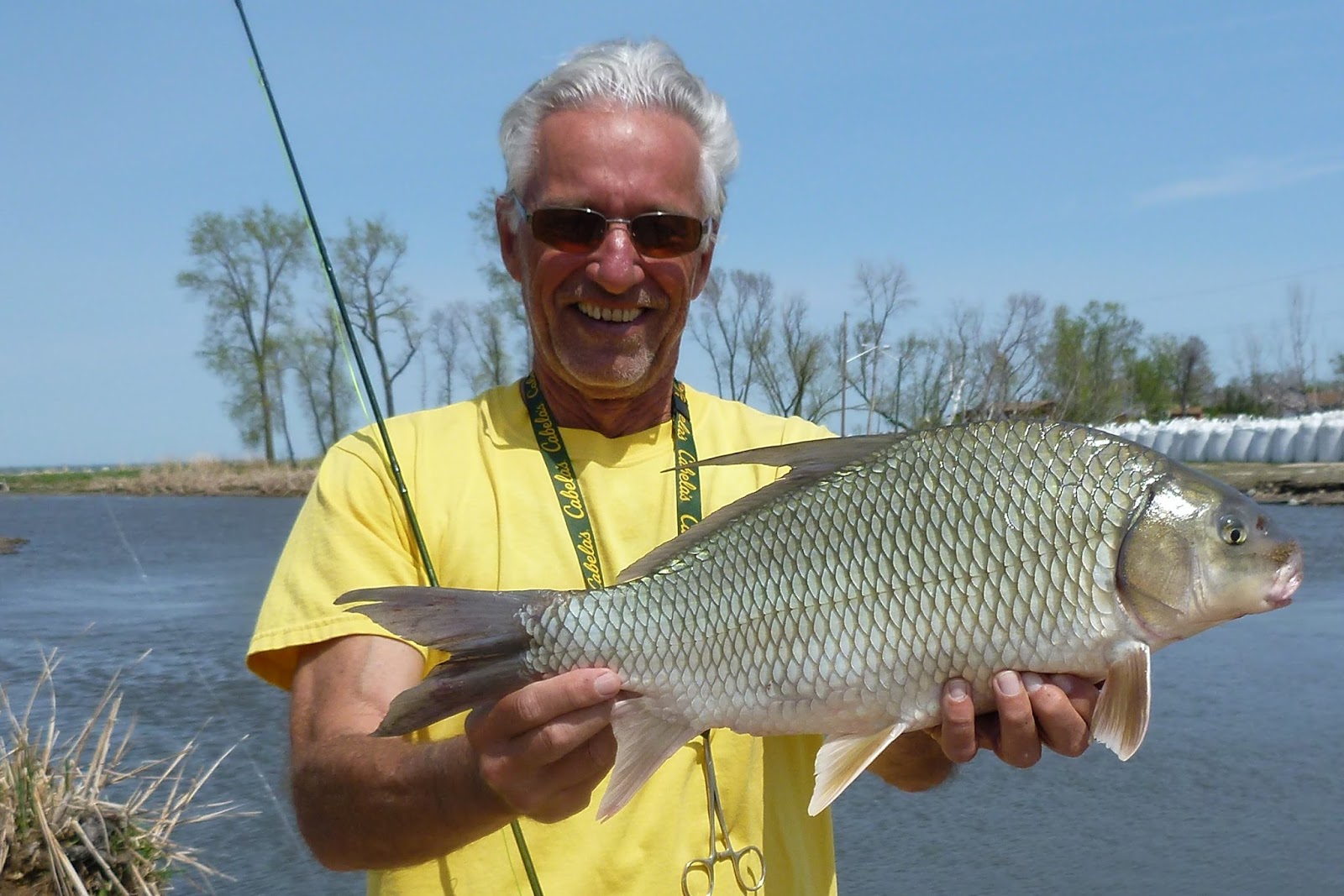
Good friend Cal and I went on the hunt for some trophy white bass, drum and carp and managed a few good ones including this nice drum. Also caught some nice MA white bass wading in Lake Winnipeg and carp up to 29.5" in Lake Manitoba. When he caught a quillback on a small jig and worm I ran for the fly rod in my car and started fishing. They were in the current in significant numbers and I eventually hooked one close enough to the mouth to call it a new fly caught species. This beauty fought as hard as any 20" trout I've ever caught.